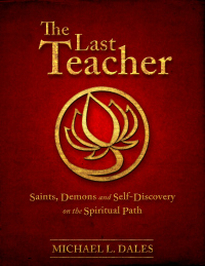
The Last Teacher: Saints, Demons and Self-Discovery on the Spiritual Path by Michael L. Dales is at once a cautionary tale as well as an inspirational guide for those awakening to their spiritual journey.
Based on journals he kept while a devotee of Amma in India and The Great Healer in Bali, Dales writes an intriguing, honest, behind-the-scenes look at ashram life, following a guru, and both his good and difficult experiences seeking spiritual awakening.
Reading the book from the perspective of the chakras, I saw the dangers of an overactive Third Eye Chakra with imbalanced lower chakras. Starting as a child, Dales had an open Third Eye Chakra, extraordinary psychic experiences, and began Transcendental Meditation at the age of seven. However, he struggled during his early adult years with feeling "at home" or experiencing the abundance that a balanced Root Chakra, for example, can offer. As his spiritual path progressed, the balancing of his other chakras became evident, and I'm so pleased that he was able the express his creativity (Sacral Chakra) and inner truth (Throat Chakra) in writing this memoir and sharing his marvelous writing talent and wisdom.
I was especially inspired by his closing words that “anyone who earnestly chooses to embark on a spiritual journey – regardless of what they believe about themselves – can become a vessel for the Light that illuminates the world.” And the world needs Light Workers today more than ever.
The book intrigued me to ask Dales the following questions:
1) Do you feel people need a guru to help them on their spiritual journey or can a person be their own best guru?
DALES: I believe that at different stages along the journey from the self to the Self, one needs a guru and at other times one needs to walk the path alone. Also, I feel that there are as many versions of the path of spiritual Awakening as there are souls. Each soul’s journey is unique. So, I would never suggest a “one size fits all approach” to spirituality. I would never recommend that everyone have a guru, or no one. To follow a teacher or not, to stay with a teacher or not, is between the individual and God. The path must be felt in one’s heart.
2) What are you doing now that you have left the ashrams behind?
DALES: Surfing… ha ha. To be serious, I am writing and I am following a path of direct connection without any human intermediaries. It is just my Divine Beloved and me now. That’s what is working for me in the moment. I don’t recommend this path to anyone nor would I discourage anyone from following suit. I believe each individual must follow their heart whether or not they are following a guru, living in an ashram, or living an entirely secular life.
3) What specific spiritual truths do you hold fast to?
DALES: The greatest spiritual truth that I can grasp is that the Divine Source — That from which we all come — is Love. Love is our Source and is our ultimate goal.
The other truth is that the path of Awakening is an ongoing process of dissolving our blocks which hold us back from knowing the Supreme Self within.
4) What do you hope readers will take away from your book?
DALES: I hope that the reader will be inspired to follow her or his own unique path to the indwelling Divinity. Perhaps those curious about the spiritual path will get a taste of it and become inspired to follow their heart’s calling to find Divinity. Maybe other readers will read about the mistakes I made and make different choices. Maybe some on the path will be reinvigorated in their quest for Awakening. In truth, I felt called to write this book, which may mean it serves some purpose beyond any that I have in mind.
5) What advice do you have for others who have inspiration to share?
DALES: Please share it. Write it. Blog it. Talk about it. Sing about it. Whatever. When I was a kid, I read Autobiography of a Yogi by Paramahansa Yogananda. That book inspired me in a way that few other things in life did. It served as a window onto the spiritual path and alerted me to the possibility of exploring different levels of consciousness. Yogananda shared his experiences and it helped me and countless others who were interested in the spiritual path. Sharing your experiences can help others, sometimes in unexpected ways. For example, even though I am not a cook, I read the autobiography of a chef and I was moved by his frank depiction of his life in the restaurants of New York. That inspired me when I sat down to write The Last Teacher. I doubt that the chef would have ever expected his book to inspire someone writing a spiritual memoir, but it did. So, I feel that if you have something to share then share it. You don’t know how it may expand consciousness for others, but it just might. Sharing your experiences can alter the consciousness of others. What you have to say can be a valuable gift to a world.
The Last Teacher is available on Amazon.com in both Kindle and print versions.
Namaste!
Becca Chopra, author of The Chakra Energy Diet, The Chakra Diaries, Chakra Secrets and Balance Your Chakras, Balance Your Life
Based on journals he kept while a devotee of Amma in India and The Great Healer in Bali, Dales writes an intriguing, honest, behind-the-scenes look at ashram life, following a guru, and both his good and difficult experiences seeking spiritual awakening.
Reading the book from the perspective of the chakras, I saw the dangers of an overactive Third Eye Chakra with imbalanced lower chakras. Starting as a child, Dales had an open Third Eye Chakra, extraordinary psychic experiences, and began Transcendental Meditation at the age of seven. However, he struggled during his early adult years with feeling "at home" or experiencing the abundance that a balanced Root Chakra, for example, can offer. As his spiritual path progressed, the balancing of his other chakras became evident, and I'm so pleased that he was able the express his creativity (Sacral Chakra) and inner truth (Throat Chakra) in writing this memoir and sharing his marvelous writing talent and wisdom.
I was especially inspired by his closing words that “anyone who earnestly chooses to embark on a spiritual journey – regardless of what they believe about themselves – can become a vessel for the Light that illuminates the world.” And the world needs Light Workers today more than ever.
The book intrigued me to ask Dales the following questions:
1) Do you feel people need a guru to help them on their spiritual journey or can a person be their own best guru?
DALES: I believe that at different stages along the journey from the self to the Self, one needs a guru and at other times one needs to walk the path alone. Also, I feel that there are as many versions of the path of spiritual Awakening as there are souls. Each soul’s journey is unique. So, I would never suggest a “one size fits all approach” to spirituality. I would never recommend that everyone have a guru, or no one. To follow a teacher or not, to stay with a teacher or not, is between the individual and God. The path must be felt in one’s heart.
2) What are you doing now that you have left the ashrams behind?
DALES: Surfing… ha ha. To be serious, I am writing and I am following a path of direct connection without any human intermediaries. It is just my Divine Beloved and me now. That’s what is working for me in the moment. I don’t recommend this path to anyone nor would I discourage anyone from following suit. I believe each individual must follow their heart whether or not they are following a guru, living in an ashram, or living an entirely secular life.
3) What specific spiritual truths do you hold fast to?
DALES: The greatest spiritual truth that I can grasp is that the Divine Source — That from which we all come — is Love. Love is our Source and is our ultimate goal.
The other truth is that the path of Awakening is an ongoing process of dissolving our blocks which hold us back from knowing the Supreme Self within.
4) What do you hope readers will take away from your book?
DALES: I hope that the reader will be inspired to follow her or his own unique path to the indwelling Divinity. Perhaps those curious about the spiritual path will get a taste of it and become inspired to follow their heart’s calling to find Divinity. Maybe other readers will read about the mistakes I made and make different choices. Maybe some on the path will be reinvigorated in their quest for Awakening. In truth, I felt called to write this book, which may mean it serves some purpose beyond any that I have in mind.
5) What advice do you have for others who have inspiration to share?
DALES: Please share it. Write it. Blog it. Talk about it. Sing about it. Whatever. When I was a kid, I read Autobiography of a Yogi by Paramahansa Yogananda. That book inspired me in a way that few other things in life did. It served as a window onto the spiritual path and alerted me to the possibility of exploring different levels of consciousness. Yogananda shared his experiences and it helped me and countless others who were interested in the spiritual path. Sharing your experiences can help others, sometimes in unexpected ways. For example, even though I am not a cook, I read the autobiography of a chef and I was moved by his frank depiction of his life in the restaurants of New York. That inspired me when I sat down to write The Last Teacher. I doubt that the chef would have ever expected his book to inspire someone writing a spiritual memoir, but it did. So, I feel that if you have something to share then share it. You don’t know how it may expand consciousness for others, but it just might. Sharing your experiences can alter the consciousness of others. What you have to say can be a valuable gift to a world.
The Last Teacher is available on Amazon.com in both Kindle and print versions.
Namaste!
Becca Chopra, author of The Chakra Energy Diet, The Chakra Diaries, Chakra Secrets and Balance Your Chakras, Balance Your Life